

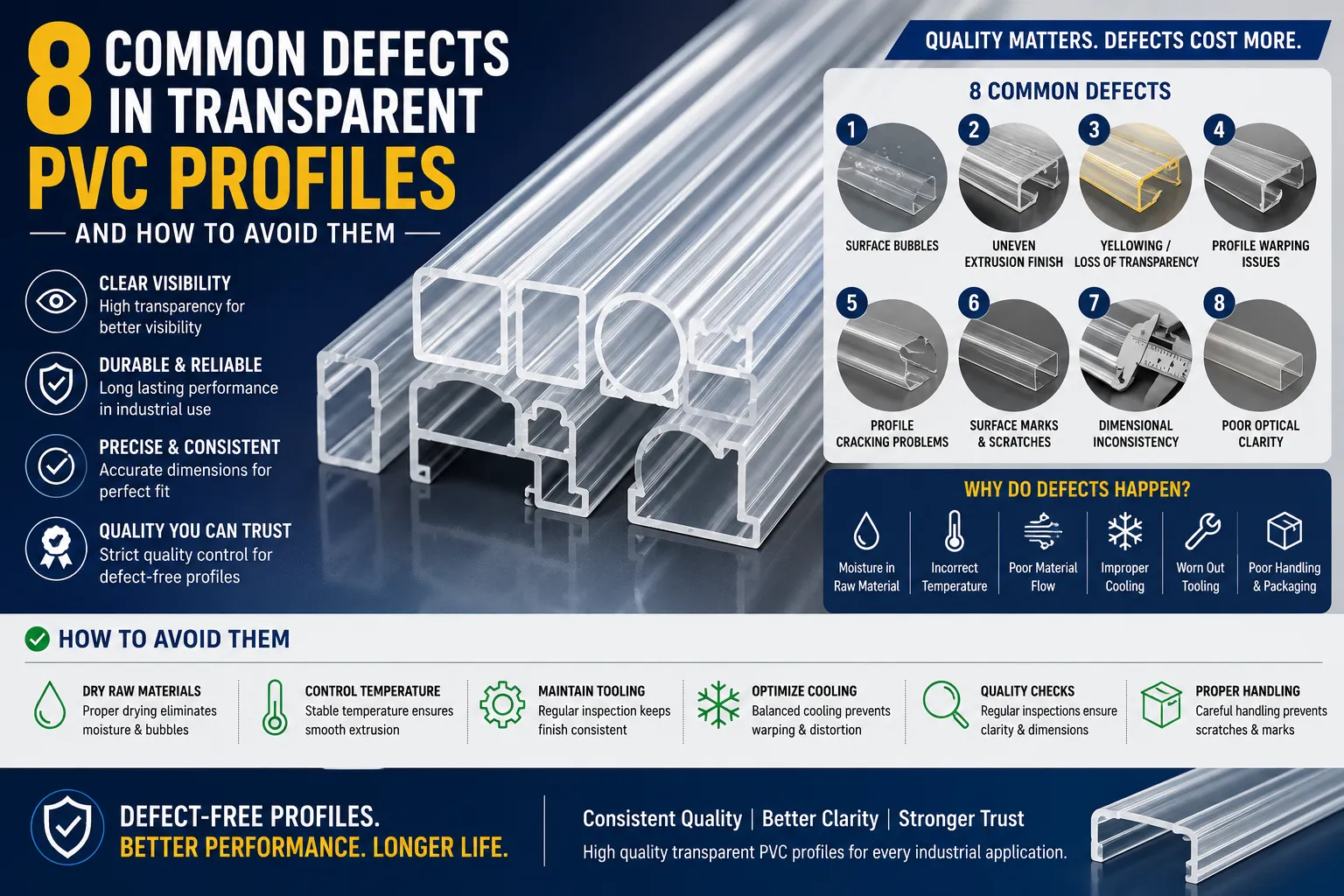
Transparent PVC profiles look simple from the outside, but manufacturing them properly is honestly more difficult than many people think.
A small issue during extrusion can affect:
- Clarity
- Surface finish
- Dimensional accuracy
- Strength
- Long-term durability
I have seen perfectly designed profiles fail because of basic processing mistakes that could have been avoided early in production.
Today, many companies working with a transparent extrusion profile manufacturer in India focus heavily on extrusion stability and quality control because industrial buyers expect clean, accurate, and visually clear profiles for repeat production.
The challenge with transparent PVC profiles is that defects become visible immediately. Unlike coloured profiles, even a small surface issue stands out clearly.
That is why quality control matters far more in transparent extrusion profiles than most people realise.
Why Transparent PVC Profile Quality Matters
Transparent PVC profiles are widely used in:
- LED lighting systems
- Refrigerator doors
- Industrial equipment covers
- Cable management systems
- Display units
- Protective enclosures
Poor quality profiles can create:
- Visibility problems
- Weak fitting performance
- Cracking
- Surface distortion
- Product rejection during assembly
For industrial applications, even a minor defect can slow down production or affect the final product appearance.
1. Surface Bubbles in PVC Profiles
One of the most common extrusion profile defects is surface bubbling.
These small air pockets reduce:
- Visual clarity
- Surface smoothness
- Product appearance
Common Causes
- Moisture in raw material
- Improper extrusion temperature
- Poor material mixing
- Air trapped during processing
How to Avoid It
- Dry raw materials properly
- Maintain stable processing temperatures
- Use controlled material feeding
- Improve extrusion line ventilation
In my experience, moisture issues in PVC extrusion are responsible for many avoidable clarity problems.
2. Uneven Extrusion Finish
Transparent profiles should have a smooth and consistent finish.
An uneven extrusion finish often appears as:
- Rough texture
- Surface lines
- Visible flow marks
- Patchy transparency
Common Causes
- Inconsistent extrusion speed
- Poor die design
- Temperature fluctuations
- Worn tooling
Prevention Tips
- Maintain stable machine settings
- Regularly inspect extrusion dies
- Use proper cooling systems
- Monitor material flow carefully
Good tooling maintenance usually solves more problems than people expect.
3. Yellowing or Loss of Transparency
This is a major issue in transparent plastic profiles.
Profiles that turn yellow quickly lose visual quality and customer acceptance.
Why It Happens
- Excessive heat exposure
- Low-quality raw materials
- UV instability
- Poor formulation balance
How to Prevent It
- Use UV stabilisers
- Control processing temperatures
- Choose better PVC compounds
- Avoid overheating during extrusion
Reliable industrial extrusion solutions always focus on long-term clarity stability.
4. Profile Warping Issues
Warping causes profiles to bend or lose dimensional accuracy after production.
This creates fitting problems during installation.
Common Causes
- Uneven cooling
- Incorrect puller speed
- Poor profile support
- Internal stress buildup
Prevention Methods
- Maintain balanced cooling
- Use proper profile calibration
- Control extrusion speed carefully
- Improve profile handling after extrusion
Dimensional consistency in extrusion becomes extremely important for industrial assembly applications.
5. Profile Cracking Problems
Cracks may appear immediately or after some time during usage.
This is one defect buyers hate because it affects both appearance and durability.
Main Reasons
- Poor material formulation
- Excessive brittleness
- Incorrect cooling
- Overheating during processing
Best Solutions
- Use balanced material compounds
- Improve extrusion cooling control
- Avoid excessive processing temperatures
- Test flexibility before mass production
Many manufacturers focus only on appearance, but strength matters equally in industrial PVC profiles.
6. Surface Marks and Scratches
Transparent PVC profiles easily show scratches and surface marks.
Even small defects become highly visible under lighting.
Causes
- Improper profile handling
- Dust contamination
- Rough machine surfaces
- Poor packaging methods
How to Reduce Surface Damage
- Keep production areas clean
- Use protective handling systems
- Improve packaging materials
- Polish contact surfaces regularly
Honestly, clean handling practices are often ignored in plastic extrusion manufacturing. That usually creates unnecessary rejection issues.
7. Dimensional Inconsistency
Transparent profiles used in industrial plastic components require precise sizing.
Even slight variation can affect:
- Assembly fitting
- Sealing performance
- Structural alignment
Common Causes
- Inconsistent puller speed
- Poor tooling precision
- Material flow instability
- Temperature variation
Prevention Tips
- Use accurate calibration systems
- Monitor extrusion pressure
- Maintain tooling regularly
- Perform dimensional inspection frequently
Custom transparent PVC profiles require tighter tolerance control compared to many standard extrusion products.
8. Poor Optical Clarity
Some profiles may technically remain transparent but still look cloudy or distorted.
This affects product quality significantly in:
- Display systems
- LED lighting
- Protective covers
- Enclosed equipment
Causes
- Low grade PVC material
- Poor cooling process
- Surface contamination
- Incorrect processing parameters
How to Improve Clarity
- Use high-quality raw material
- Optimise extrusion cooling defects
- Maintain stable extrusion temperatures
- Improve surface polishing
Good extrusion quality plays a major role in the long-term performance of transparent PVC profiles for enclosed systems used in industrial equipment.
Quick Defect Prevention Checklist
| Defect | Main Cause | Prevention |
|---|---|---|
| Surface bubbles | Moisture | Proper material drying |
| Uneven finish | Poor tooling | Stable extrusion settings |
| Yellowing | Overheating | UV-stabilised compounds |
| Warping | Uneven cooling | Controlled cooling systems |
| Cracking | Brittle formulation | Better material balance |
| Surface scratches | Poor handling | Cleaner processing |
| Dimensional issues | Speed variation | Accurate calibration |
| Clarity problems | Low-quality material | Better PVC compounds |
Why Quality Control Matters in Transparent Profiles
Transparent extrusion profiles require stricter quality control than coloured profiles.
Even minor defects become visible instantly.
A proper PVC profile quality control process usually includes:
- Material inspection
- Temperature monitoring
- Dimensional testing
- Surface inspection
- Clarity evaluation
- Cooling stability checks
Reliable manufacturers understand that visual quality is just as important as structural performance.
Real Production Problems That Often Get Ignored
One thing I notice often is that manufacturers focus heavily on machine speed.
Faster production sounds good on paper, but rushing transparent profile extrusion usually creates:
- Surface distortion
- Cooling imbalance
- Internal stress
- Poor transparency
What usually works better is slower, stable production with consistent temperature control.
In transparent profile manufacturing, consistency almost always beats speed.
Why Industrial Buyers Prefer Experienced Manufacturers
Industrial buyers need:
- Repeat production consistency
- Stable dimensions
- Clear transparency
- Reliable packaging
- Long-term supply support
Companies like M3 Extrusion manufacture custom plastic extrusion profiles for industrial applications where transparency, dimensional accuracy, and repeat production quality are important for commercial use.
Final Thoughts
Transparent PVC profiles may appear simple, but producing high-quality profiles consistently takes proper process control, good material selection, and careful handling.
Most defects usually come from:
- Poor temperature control
- Moisture contamination
- Weak cooling systems
- Inconsistent processing
From what I have seen, manufacturers that focus on extrusion stability instead of maximum production speed usually achieve much better long-term quality results.
And in transparent extrusion, quality problems are impossible to hide.
FAQs
What causes bubbles in transparent PVC profiles?
Bubbles usually happen because of trapped moisture, unstable extrusion temperatures, or poor material handling. Proper raw material drying and stable machine settings help reduce surface bubbles in transparent PVC profiles.
Why do transparent PVC profiles turn yellow over time?
Yellowing often happens because of overheating, UV exposure, or low-quality raw materials. Using UV-stabilised PVC compounds and maintaining proper extrusion temperatures helps preserve long-term transparency.
How can manufacturers improve PVC profile clarity?
Manufacturers improve clarity by using high-quality PVC compounds, stable cooling systems, proper extrusion temperatures, and clean production environments. Better processing control usually leads to smoother and clearer transparent profiles.
What causes warping in transparent extrusion profiles?
Warping is commonly caused by uneven cooling, poor calibration, or inconsistent extrusion speed. Balanced cooling systems and controlled profile handling help maintain dimensional stability after production.
Why are scratches common in transparent PVC profiles?
Transparent profiles show scratches more easily because defects remain highly visible on clear surfaces. Clean handling systems, dust control, and proper packaging reduce surface damage during production and transport.
Are transparent PVC profiles suitable for industrial applications?
Yes, transparent PVC profiles are widely used in industrial equipment, LED lighting systems, display units, and protective covers because they offer visibility, lightweight performance, and moisture resistance.
What is the most important factor in transparent PVC profile manufacturing?
Consistent process control is usually the most important factor. Stable extrusion temperatures, proper cooling, and good material quality help prevent most common extrusion profile defects.